
7th Hydrogen Engine Conference 2026
REVIEW 2026
The Program
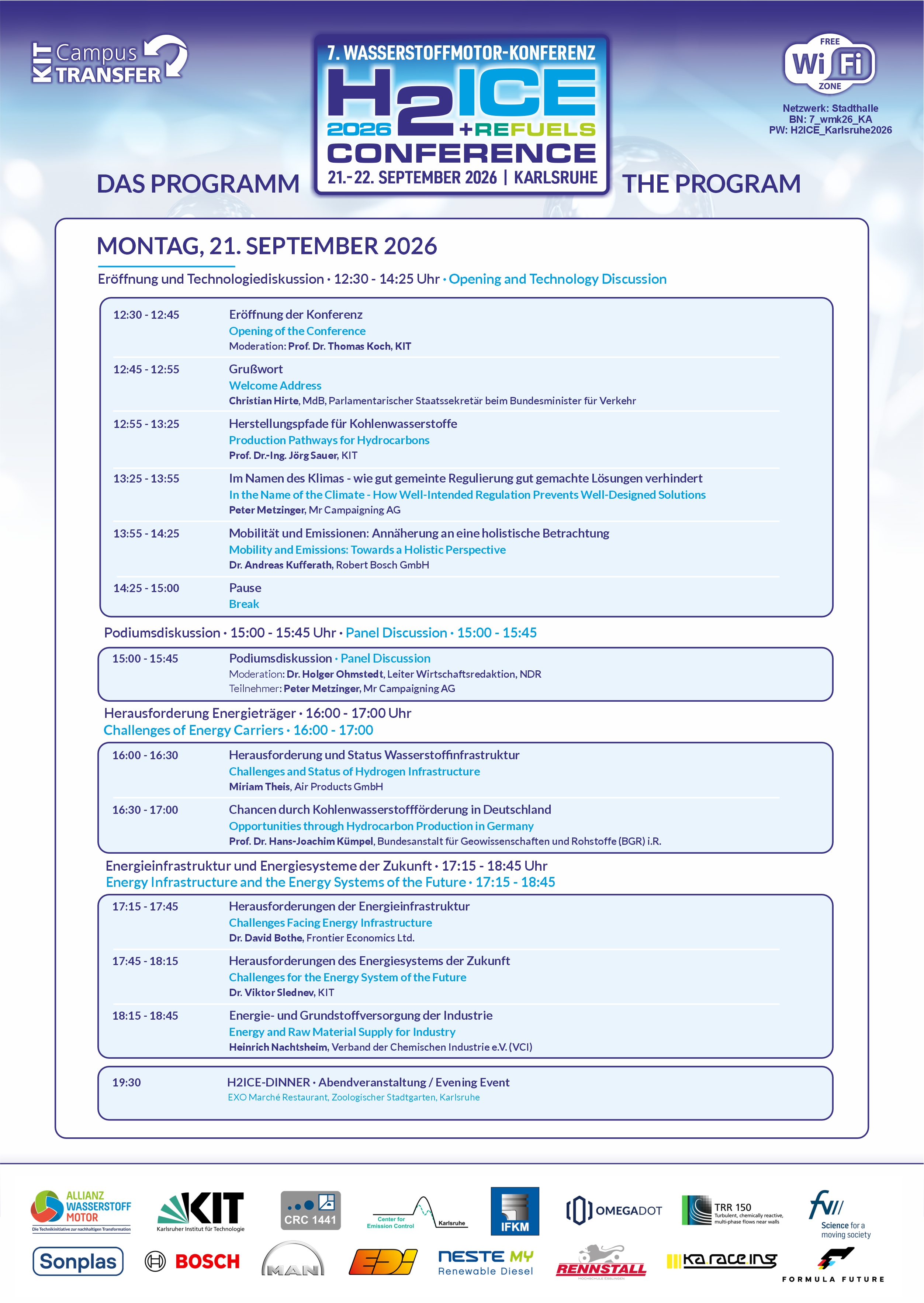
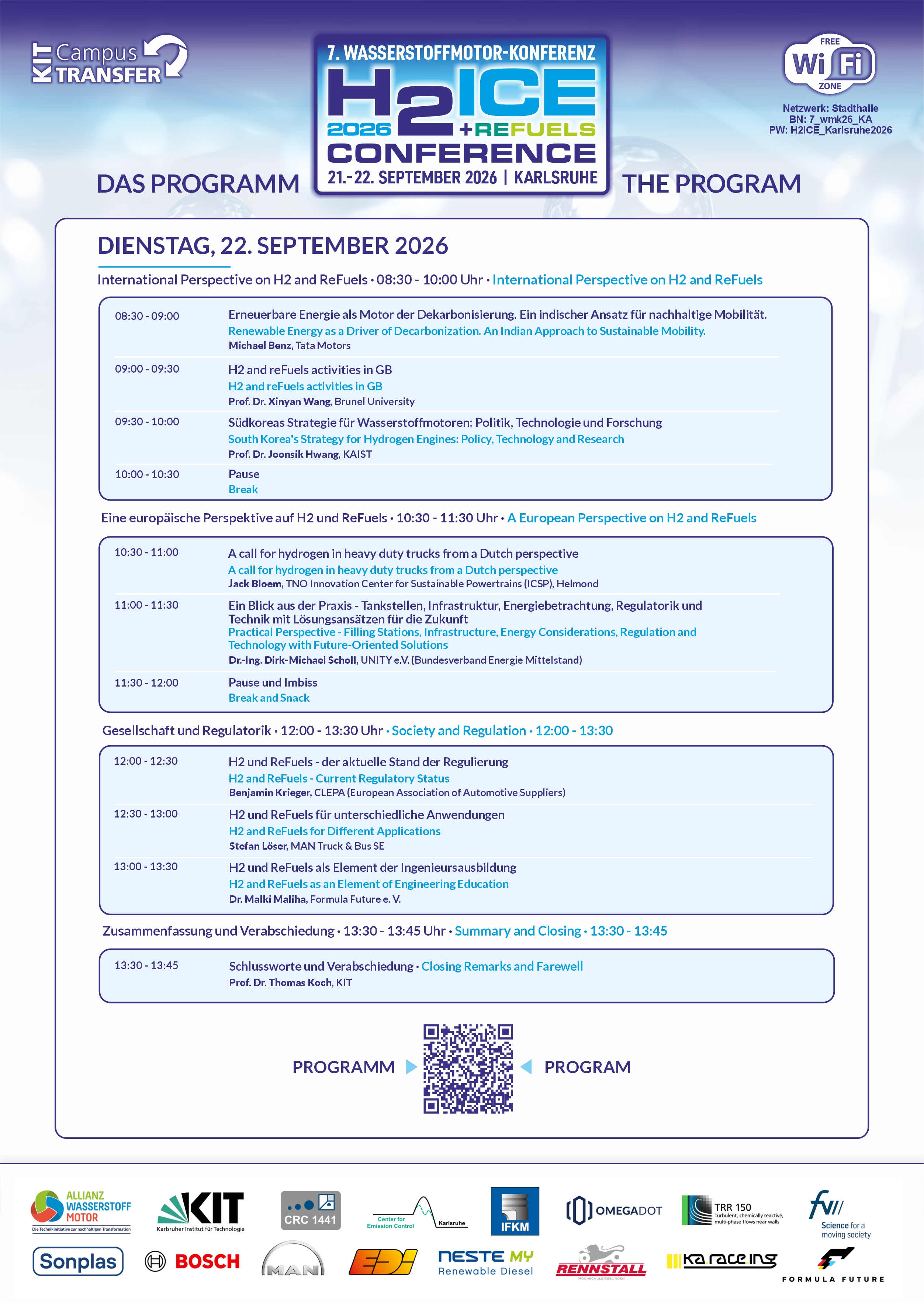
The speakers and the topics
Prof. Dr.-Ing. Jörg Sauer, KIT
“The transformation of the refinery landscape and the associated transition to ReFuels and renewable hydrocarbons as chemical feedstocks are of outstanding importance for Germany as a business location and for its energy supply.”
Peter Metzinger, Mr. Campaigning AG
“The EU ban on combustion engines is not merely the result of technical considerations but also of a campaign strategically funded over many years—one to which the industry and proponents of technological openness failed to mount an equivalent communications response—leaving key questions regarding the energy system, such as the existing vehicle fleet, storage, and import dependency, largely unanswered.”
Dr. Andreas Kufferath, Robert Bosch GmbH
“Diversity in powertrain technologies and energy carriers is not a transitional solution, but an economic, ecological, and technological necessity. H₂ and ReFuels are part of this.”
Miriam Theis, Air Product GmbH
“Where does the real challenge lie in developing hydrogen infrastructure? It is not in the technology itself, but rather in the combination of factors such as the availability of green H2 molecules, supply pathways, missing standards and operational details that must come together to transform a promising concept into a reliable, functioning hydrogen economy.”
Prof. Dr. Hans-Joachim Kümpel, Federal Institute for Geosciences and Natural Resources, retired
“By ecological production of domestic shale gas Germany may cover 25 % of its present gas needs – for decades.”
Dr. David Bothe, Frontier Economics Ltd.
“Energy infrastructure is an often underestimated key factor in determining which powertrains and fuels will prevail.”
Dr. Viktor Slednev, IIP KIT
“There is no single least-cost pathway to a resilient net-zero energy system. Different combinations of electrification, hydrogen, PtX, storage, infrastructure and imports can achieve similar system costs, but their robustness, regional impacts and exposure to supply risks differ substantially. Therefore, future energy-system planning must explicitly link local technology choices with regional networks, global supply chains and uncertainty.”
Heinrich Nachtsheim, VCI
“The transformation of the chemical industry will require significant amounts of green electricity, hydrogen, and CO₂ circular solutions by 2045. For this to succeed, suitable framework conditions must urgently be established—including competitive overall electricity costs, a practically viable regulatory framework for hydrogen, and long-term regulatory certainty.”
Michael Benz, Tata Motors
“Electrons and molecules will go hand in hand for the future sustainable mobility solutions.”
Prof. Dr. Xinyan Wang, Brunel University
“It is a challenging and uncertain period. We need to come together as an engine community to tackle not only the technical challenges, but also go out of our technical or academic comfort zone to speak to the public and policy makers, fighting for a future for ourselves and the society.”
Prof. Dr. Joonsik Hwang, KAIST
“Hydrogen is South Korea's critical strategy to achieve transport decarbonization and 2050 carbon neutrality; it is not an option, but a necessity.”
Jack Bloem, TNO
“In the Netherlands hydrogen is slowly on its way to claim its space. I recommend that Europe reviews and reuses the Dutch ERE-Ticketing System in order to reduce H2 prices.”
Dr.-Ing. Dirk Michael Scholl, UNITY e.V.
“For the future, we need both molecules and electrons to achieve defossilization. E-fuels are one of the promising building blocks, as they can be used to power both existing drive systems and new, highly efficient powertrains, while the necessary infrastructure is already in place.”
Benjamin Krieger, CLEPA
“The hydrogen engine is not excluded under EU law. However, technical recognition alone does not create a market. Vehicle regulation, fuel policy, infrastructure, and investment conditions now need to be brought together. The debate on renewable fuels is still open.”
Stefan Löser, MAN Truck & Bus
“Decarbonization begins with application: Dual Fuel bridges today’s customer requirements with the fuels and infrastructure of tomorrow.”
Dr. Malki Maliha, Formula Future e.V.
“Young people are still enthusiastic about exploring different energy sources – and you, as representatives of companies, have the opportunity to actively shape their education and training!”